

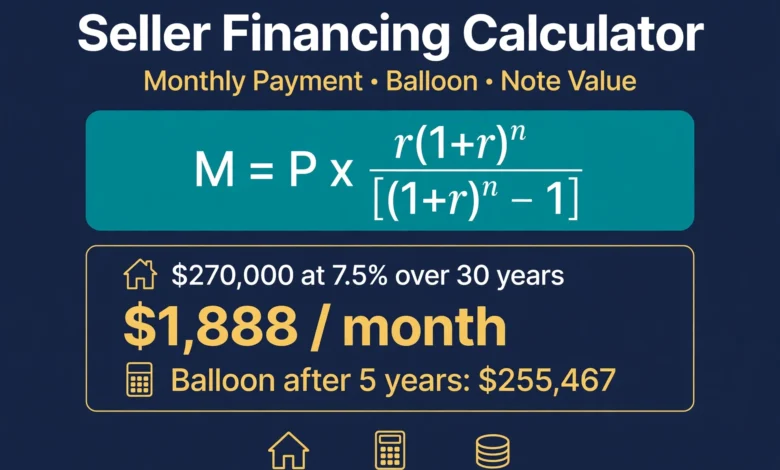
A seller financing calculator turns four numbers into the answer both sides of a deal actually live with: how much the buyer pays every month, how much is still owed when the balloon comes due, and what the seller’s note is worth if it is sold. You enter the sale price, the down payment, the interest rate, and the term, and it does the rest.
Take the example this guide uses throughout. A home sells for $300,000 with 10% down, so the seller finances $270,000 at 7.5% over 30 years. The monthly payment is $1,887.88. If the note has a five-year balloon, the buyer pays $1,887.88 a month for five years and then owes a lump sum of $255,467.08. Every figure here is worked out with the formula below, so you can check the maths yourself.
What Seller Financing Is
Seller financing, also called owner financing or a seller carry-back, is simple: the seller acts as the bank. Instead of the buyer borrowing the whole price from a lender, the seller lends part of the purchase price to the buyer, and the buyer pays the seller principal and interest every month under a written agreement called a promissory note. The note is secured by the property, usually with a mortgage or deed of trust, so if the buyer stops paying, the seller can foreclose.
It is used most often when a buyer cannot get a bank loan, or when a seller wants a steady monthly income instead of a single lump sum. A seller who owns a property outright can earn interest for years. A buyer who cannot get a bank loan can still buy, because the seller sets the terms.
The deal has five moving parts. The sale price is what the buyer agrees to pay. The down payment is the cash paid on closing day. The note amount is the sale price minus the down payment. The interest rate is the yearly rate in the note. The amortization term is the number of years the payment is calculated over. A sixth part, the balloon term, is optional but common: the years before the whole remaining balance comes due.
A calculator does not decide whether the deal is a good idea. It shows what the deal costs, month by month, so both sides can see it before they sign.
The Payment Formula, Explained Simply
The monthly payment on a fixed-rate note comes from one formula:
M = P × [r(1 + r)^n] / [(1 + r)^n − 1]
It looks harder than it is. Each letter is one of the inputs above. P is the note amount, the part the seller finances. r is the monthly interest rate, which is the yearly rate divided by 12. n is the number of monthly payments, which is the amortization term in years multiplied by 12. M is the monthly payment that comes out.
Work through the example. The note is $270,000, so P is 270,000. The yearly rate is 7.5%, so the monthly rate r is 0.075 divided by 12, which is 0.00625. The term is 30 years, so n is 360 payments. The monthly payment M comes out at $1,887.88.
The payment never changes, but what is inside it changes every month. In the first month, the interest part is $270,000 times 0.00625, which is $1,687.50. The rest of the payment, $200.38, pays down the balance. After a year, the balance is still $267,511.05 — a slow start, because most early payments go to interest.
This is the same maths behind a regular mortgage — and behind how a fixed monthly payment is worked out on an installment loan.
Worked Example 1: The $300,000 Home
A home sells for $300,000. The buyer puts 10% down, which is $30,000, paid in cash on the day the deal closes. The seller finances the remaining $270,000 at 7.5% a year, amortized over 30 years, with monthly payments and no balloon.
The monthly payment is $1,887.88. Over 360 payments, the buyer pays $679,636.50 in total. Subtract the $270,000 borrowed, and the total interest is $409,636.50 — more than the amount borrowed.
| Line | Amount |
|---|---|
| Sale price | $300,000 |
| Down payment (10%) | $30,000 |
| Note amount financed | $270,000 |
| Interest rate | 7.5% a year |
| Amortization term | 30 years (360 payments) |
| Monthly payment | $1,887.88 |
| Total paid over 30 years | $679,636.50 |
| Total interest | $409,636.50 |
Two things stand out. First, how much of the early payments is interest: in month one, $1,687.50 of the $1,887.88 payment is interest and only $200.38 is principal. Second, what the down payment does: if the buyer had put 20% down instead of 10%, the note would be $240,000, the payment $1,678.11 a month, and the total interest $364,119.60.
It helps to know how APR and APY differ before agreeing to a rate.
Worked Example 2: The Same Deal With a 5-Year Balloon
Most seller-financed deals do not run for 30 years. The payment is calculated over 30 years to keep it affordable, but the note ends much sooner with a balloon payment: one lump sum that pays off whatever is left.
Take the same deal: $270,000 financed at 7.5%, amortized over 30 years, so the monthly payment is still $1,887.88. But this time the note has a five-year balloon. The buyer pays $1,887.88 a month for 60 months, and then the entire remaining balance comes due at once.
After 60 payments, the remaining balance is $255,467.08. That is the balloon. The buyer has paid $113,272.80 in 60 payments, but only $14,532.92 of that went to principal; the rest, $98,739.88, was interest. The balloon is almost as large as the original note, because five years of payments on a 30-year schedule barely dents the balance.
| Line | Amount |
|---|---|
| Note amount financed | $270,000 |
| Interest rate | 7.5% a year |
| Amortization term | 30 years (360 payments) |
| Monthly payment | $1,887.88 |
| Balloon term | 5 years (60 payments) |
| Paid in 60 monthly payments | $113,272.80 |
| Of which: interest | $98,739.88 |
| Of which: principal | $14,532.92 |
| Balloon due at month 60 | $255,467.08 |
A balloon is not a surprise if both sides plan for it. The buyer usually plans to refinance with a bank before the balloon date, or to sell the property, or to pay the balloon from savings. If the plan fails, the seller can foreclose, and the buyer loses the home and the money already paid. A buyer should never agree to a balloon without a realistic plan for the balloon date, written down before signing.
You may also like:
| Related Article |
|---|
| Installment Loans Explained: How They Work, Types and Costs 2026 |
| Private Money Lending: How It Works for Real Estate Investors 2026 |
Rate Comparison: What 1.5% Does to the Payment
The interest rate is the single most powerful number in the deal. The table below holds everything else fixed — the same $270,000 note, the same 30-year amortization — and changes only the rate.
| Yearly rate | Monthly payment | Total paid | Total interest |
|---|---|---|---|
| 6.0% | $1,618.79 | $582,763.11 | $312,763.11 |
| 7.5% | $1,887.88 | $679,636.50 | $409,636.50 |
| 9.0% | $2,172.48 | $782,093.18 | $512,093.18 |
Moving from 6% to 7.5% raises the payment by $269.09 a month and adds $96,873.39 of interest. Moving from 7.5% to 9% raises the payment by another $284.60 a month and adds $102,456.68 more. Between the lowest and the highest rate in the table, the monthly payment differs by $553.69 and the total interest differs by $199,330.07 — on the same $270,000 note.
That is why the rate deserves the most negotiation. Small differences in the rate are not small differences in money.
Seller-financed rates often run 6% to 10%, a little above bank rates, because the seller takes more risk than a bank.
Term Comparison: 15 Years vs 30 Years
The amortization term is the second most powerful number. A shorter term means a higher monthly payment but far less total interest. Here is the same $270,000 note at 7.5%, calculated over 15 years instead of 30.
| Term | Monthly payment | Total paid | Total interest |
|---|---|---|---|
| 15 years | $2,502.93 | $450,528.01 | $180,528.01 |
| 30 years | $1,887.88 | $679,636.50 | $409,636.50 |
The 15-year payment is $615.05 a month higher, which is a real burden. But the total interest is $229,108.49 lower. The buyer who can afford the higher payment saves almost a quarter of a million dollars in interest and owns the home outright in half the time.
The trade-off is cash flow against total cost. A 30-year amortization keeps the monthly payment low, which is usually what makes the deal possible for the buyer. A 15-year amortization costs much less in total, but only if the buyer can actually make the higher payment every month without fail. A higher payment that is missed twice is worse than a lower payment always made on time.
Many deals split the difference: the payment is calculated over 30 years, the balloon comes due in 5 to 7 years, and both sides treat the balloon date as the real end of the deal.
What Your Note Is Worth If You Sell It
A seller who holds a note does not have to keep it. Notes are bought and sold, and the price is almost always less than the face value, because the buyer wants a higher return than the rate written in the note.
The value of a note is the present value of everything it will pay: the monthly payments until the balloon, plus the balloon itself, discounted at the yield the note buyer requires. A dollar paid five years from now is worth less than a dollar today, and the higher the yield the buyer wants, the less they will pay.
Use the same deal: a $270,000 note at 7.5%, amortized over 30 years, with a five-year balloon. The payment is $1,887.88 a month and the balloon is $255,467.08. If a note buyer wants a 10% return, they will pay $244,123.71 for it — 90.4% of face value, a discount of $25,876.29.
| Line | Amount |
|---|---|
| Note face value | $270,000 |
| Monthly payment | $1,887.88 |
| Balloon after 5 years | $255,467.08 |
| Buyer’s required yield | 10% a year |
| What the buyer pays today | $244,123.71 |
| As a share of face value | 90.4% |
| Discount | $25,876.29 |
Three things move that price: the rate in the note, the yield the buyer wants, and the risk. A note paying 9% is worth more than one paying 7.5%; a buyer who will accept 8% pays more than one who insists on 10%; and a note with a large down payment, a buyer with a strong payment history, and a property worth more than the note is worth more than the opposite.
A higher rate in the note, a bigger down payment, and a shorter balloon all make the note easier to sell and worth more when it is sold.
Seller vs Buyer: What Each Side Should Check
Seller financing only works when both sides check the other side’s numbers. The checks are different for each side, because the risks are different.
The seller should check the buyer’s ability to pay: proof of income, a look at the buyer’s debts, and a down payment large enough to show the buyer has something at stake. A buyer with 10% down has $30,000 of their own money in the deal. The seller should also check the property’s value and record the mortgage or deed of trust, so the note is enforceable.
The buyer should check the seller’s right to sell: a title search, to confirm the seller actually owns the property and there are no hidden liens or claims on it. The buyer should also check whether the seller still owes a mortgage on the property, which the seller’s lender could demand in full. The buyer should get the rate, the payment, the balloon date, and the late-payment terms in writing.
Both sides should check the law. In the United States, seller financing is subject to rules many people do not expect. Dodd-Frank ability-to-repay rules and state interest-rate caps can apply, and under the installment sale rules a seller can often spread the tax on the gain over the years the payments arrive. A short conversation with a real estate lawyer before signing is cheaper than a dispute after it.
It also helps to have a separate emergency cushion in place before taking on a note, so a missed payment or a broken roof does not force a sale at the worst possible time.
Common Mistakes to Avoid
The first mistake is agreeing to a balloon with no plan for the date it comes due. Before signing, the buyer should know exactly how the balloon will be paid: a refinance, a sale, or savings.
The second mistake is a down payment that is too small. A buyer with 0% or 5% down has little to lose by walking away. Ten percent is a common minimum.
The third mistake is skipping the paperwork. A note that is not in writing, a mortgage that is not recorded, or a title that is not searched can turn a good deal into a legal mess. A lawyer and a title search cost a tiny fraction of the price of the property.
The fourth mistake is ignoring the interest rate’s effect on the total cost. The difference between 6% and 9% is $199,330.07 of interest on the same note, so the rate is worth negotiating as hard as the price.
The fifth mistake is the seller forgetting the note may need to be sold. A note at a below-market rate with a tiny down payment is hard to sell and worth far less than its face value.
The sixth mistake is treating the monthly payment as the whole cost. The buyer also pays property taxes, insurance, and maintenance. A deal that works on the payment alone can fail once those costs are added in.
It also helps to set aside money every month automatically, so the payment, the taxes, and the insurance are covered even in a slow month.
You may also like:
| Related Article |
|---|
| How to Save for a House Deposit: A Simple Step-by-Step Plan 2026 |
| Beginner Investment Guide: How to Start Investing with Confidence |
Conclusion
A seller financing calculator shows what a deal costs before anyone signs it. Four numbers go in — the sale price, the down payment, the rate, and the term — and three answers come out: the monthly payment, the balloon, and the value of the note. On the $300,000 home in this guide, 10% down and 7.5% over 30 years means $1,887.88 a month, $409,636.50 of total interest, and a $255,467.08 balloon if the note ends after five years.
The numbers reward the same habits that make any loan work: a bigger down payment, a lower rate, and a shorter term all cut the total cost, while a balloon only works when there is a real plan for the balloon date. Run the numbers before you negotiate, not after.
FAQs
What does a seller financing calculator do?
It works out the monthly payment, the total interest, the balloon payment, and the value of the note from four inputs: the sale price, the down payment, the interest rate, and the amortization term. It uses the same amortization formula as a mortgage.
How is the monthly payment on seller financing calculated?
With the formula M = P × [r(1 + r)^n] / [(1 + r)^n − 1], where P is the note amount, r is the yearly rate divided by 12, and n is the number of monthly payments. For a $270,000 note at 7.5% over 30 years, that is $1,887.88 a month.
What is a balloon payment in seller financing?
A balloon is a large lump sum that pays off the remaining balance of the note on a set date, usually 3 to 7 years after the deal closes. The payment is calculated over a long term, often 30 years, so the balance barely falls. On the $270,000 example, the balloon after five years is $255,467.08.
What is a typical interest rate for seller financing?
Rates are often in the range of 6% to 10% a year, usually a little above bank mortgage rates, because the seller takes more risk than a bank. On a $270,000 note over 30 years, the difference between 6% and 9% is $199,330.07 of total interest.
Why would a seller sell their note for less than its face value?
Because the note buyer wants a higher return than the rate in the note. A $270,000 note at 7.5% with a five-year balloon is worth $244,123.71 to a buyer who wants 10%, which is 90.4% of face value. A higher rate, a bigger down payment, and a shorter balloon all make the note worth more.
Is seller financing legal?
Yes, in general, but it is subject to rules that vary by place and by how many deals the seller does. Both sides should get a real estate lawyer to check the paperwork before signing.