
APR and APY look almost the same. They are only one letter apart, they are both shown as a yearly percentage, and they both appear on the same bank pages. Yet they mean opposite things. One tells you what borrowing will cost you. The other tells you what saving will earn you. Mix them up, and you can pick the wrong loan, the wrong savings account, or both.
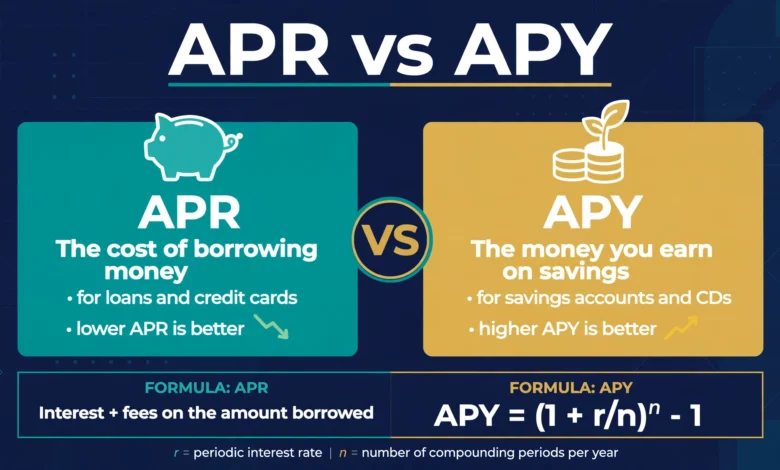
Here is the short version. APR is the rate you pay to borrow money. APY is the rate you earn on money you save. The real difference is compounding. APY includes the effect of interest earning interest inside the year. APR, in the way it is usually quoted, does not.
This guide explains APR vs APY in plain English: what each one means, how each one is calculated, where you see each one, and how to use them to compare a loan, a credit card, and a savings account. All of the numbers below are worked examples, not live rates. Rates change often, so always check the current rate before you apply.
APR vs APY at a Glance
| APR | APY | |
|---|---|---|
| Full name | Annual Percentage Rate | Annual Percentage Yield |
| What it measures | What you pay to borrow | What you earn on savings |
| Where you see it | Loans, mortgages, credit cards | Savings accounts, CDs, money market accounts |
| Compounding inside the year | Usually not included | Included |
| Fees | Often included for loans | Not included |
| What you want | The lowest number | The highest number |
| Governed by | Truth in Lending Act, Regulation Z | Truth in Savings Act, Regulation DD |
That last row matters. Banks and lenders do not choose these labels freely. In the United States, the law tells them which number to show you for each product. That is why the same bank can show you a 21% APR on a credit card and a 4% APY on a savings account on the same day, and both numbers can be correct.
What Is APR?
APR stands for Annual Percentage Rate. It is the yearly cost of borrowing money, shown as a percentage. When you take out a loan, a mortgage, or use a credit card, the APR is the number that is meant to help you compare the true cost of that borrowing.
For a loan, the APR is usually more than the interest rate alone, because it folds in many of the fees you pay to get the loan, such as an origination fee, discount points on a mortgage, and some closing costs. That is the point of APR. Two loans can have the same interest rate and still cost very different amounts once fees are added.
For a credit card, APR works a little differently. A card issuer usually does not fold upfront fees into the APR, so on most cards the APR and the interest rate are the same number. Annual fees, late fees, and foreign transaction fees are charged separately and are not baked into the APR.
An APR example with real dollars
Imagine you borrow $10,000 on a personal loan with an interest rate of 8% and no fees. The APR would also be about 8%, and the interest for one year would be about $800 if the balance stayed the same all year.
Now imagine a second loan for the same $10,000 at the same 8% interest rate, but with a $300 origination fee. The interest rate is still 8%, but the APR would be higher, because that $300 fee is part of the cost of borrowing. The APR tells you the second loan is more expensive, even though the headline interest rate looks the same.
Mortgages work the same way. A lender may offer you a 6.50% interest rate, but once points and closing costs are included, the APR may be 6.75% or higher. If you only compare interest rates, the two offers look identical. If you compare APRs, the cheaper loan is clear.
APR can also understate what you really pay, because it is usually quoted without compounding inside the year. A card with a 21% APR does not charge you 21% once a year. It divides that rate by 365 and charges interest day by day, so the effective yearly cost is about 23.36%. On a $1,000 balance carried all year, that is about $24 more. Pay in full every month and you usually pay no interest at all.
What Is APY?
APY stands for Annual Percentage Yield. It is the yearly return you earn on money you save or deposit, shown as a percentage. When a bank advertises a savings account, a certificate of deposit, or a money market account, the APY is the number it shows you.
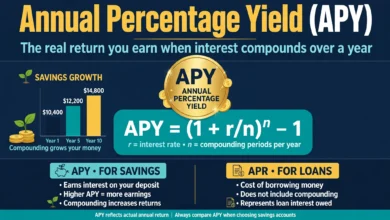
APY is different from APR in one clear way: it includes compounding. It tells you how much your money will grow in a year if you leave it alone, including the interest that your interest earns. That is why APY is almost always a little higher than the nominal interest rate on the same account.
APY does not include fees. If an account charges a monthly fee, that fee is not taken out of the APY. A high APY on an account with a $5 monthly fee can still be a bad deal on a small balance, because the fee can wipe out a whole year of interest.
An APY example with real dollars
Imagine you put $10,000 in a savings account that pays 4.00% APY. If the rate stays the same for a full year and you do not add or withdraw any money, you will earn about $400. That is the whole point of APY. It already includes compounding, so the number you see is close to the amount you actually receive.
Now compare that with a regular savings account at a large bank. The national average for a regular savings account has been around 0.38% to 0.39% APY. On the same $10,000, that account would earn about $39 in a year. The difference is about $361 a year on the same money, with the same safety. That is why APY matters, and why it is worth moving your savings to an account that pays more interest instead of leaving it where it earns almost nothing.
| Balance | At 0.39% APY | At 4.00% APY | At 5.00% APY |
|---|---|---|---|
| $100 | $0.39 | $4.00 | $5.00 |
| $1,000 | $3.90 | $40.00 | $50.00 |
| $5,000 | $19.50 | $200.00 | $250.00 |
| $10,000 | $39.00 | $400.00 | $500.00 |
On $100, the difference looks tiny. On $10,000, it is hundreds of dollars a year. And the gap grows over time, because the interest you earn in year one also earns interest in year two.
The One Difference That Explains Everything: Compounding
Compounding means earning interest on interest. It is the single idea that separates APR from APY, and once you understand it, the two terms stop being confusing.
Simple interest only pays interest on your original amount. If you save $1,000 at 5% simple interest, you earn $50 in a year, and the next year you earn $50 again on the same $1,000.
Compound interest is different. The interest you earn is added to your balance, and then it earns interest too. If you save $1,000 at 5% compounded monthly, you earn $51.16 in a year, not $50. The extra $1.16 is small on $1,000, but it grows with the balance and with time.
APR is usually quoted without that effect inside the year. APY is quoted with it. That is why, for the same underlying rate, APY is always the higher number.
The Formulas: How to Convert APR to APY
You do not need to memorise these formulas to use APR and APY well. But if you want to check a bank’s maths, this is the formula that connects them.
APY = (1 + r / n) ^ n – 1
In this formula, r is the nominal annual rate as a decimal, and n is the number of compounding periods in a year. If interest compounds monthly, n is 12. If it compounds daily, n is 365. Compounds once a year, n is 1, and APY is exactly the same as the nominal rate.</p>
| Compounding | n | APY on a 5% nominal rate | Interest on $1,000 in one year |
|---|---|---|---|
| Annually | 1 | 5.00% | $50.00 |
| Semi-annually | 2 | 5.06% | $50.63 |
| Quarterly | 4 | 5.09% | $50.95 |
| Monthly | 12 | 5.12% | $51.16 |
| Daily | 365 | 5.13% | $51.27 |
Three things are worth noticing. First, most of the gain comes from moving from annual to monthly compounding. Moving from monthly to daily adds only a tiny amount. Second, the gap grows as the rate grows. Third, when two savings accounts show the same APY, they will earn you the same amount in a year, even if one compounds daily and the other compounds monthly. The APY already accounts for that difference, so APY is the right number to compare for savings.
You may also like:
- How to Open a High-Yield Savings Account With $100 in 2026
- Emergency Fund: How to Build Savings for Unexpected Expenses
APR vs Interest Rate, and APY vs Interest Rate
The interest rate is the cost of borrowing the principal only, with no fees added. APR is the interest rate plus many of the fees that come with the loan, shown as a single yearly percentage. That is why, on a mortgage or a personal loan, the APR is usually higher than the interest rate. If two loans have the same interest rate but different APRs, the one with the lower APR is cheaper, because its fees are lower. On a credit card, the two numbers are usually the same, because the issuer does not fold upfront fees into the APR. Annual fees and late fees are still charged separately.
APY works the other way round. The interest rate on a savings account is the nominal rate, before compounding. APY is that same rate after compounding is included. APY is always equal to or higher than the interest rate, and the two are only the same when interest compounds once a year. A savings account may have a nominal interest rate of 4.00% compounded monthly, and its APY would be about 4.07%. Compare savings accounts by APY, not by interest rate.
Where You See APR and Where You See APY
Ask one question: am I borrowing or am I saving? If you are borrowing, you will see APR. If you are saving, you will see APY.
APR appears on credit cards, personal loans, auto loans, mortgages, and home equity loans. On a credit card, the APR is usually shown as a range, such as 19.99% to 28.99%, because the rate you get depends on your credit. A card can also have more than one APR: one rate for purchases, a higher rate for cash advances, another for balance transfers, and a penalty APR if you pay late. Check the cash advance rate before you use a card for one. According to Federal Reserve data, the average rate on credit card accounts in the United States was around 21% in early 2026, and higher for accounts that were actually being charged interest.
APY appears on savings accounts, high-yield savings accounts, certificates of deposit, and money market accounts. A high-yield savings account may show an APY of around 4% in 2026, while a regular savings account at a large bank may show less than 0.50%.
APY also appears in crypto, where it is used to describe the return on staking or lending a digital asset. The maths is the same, but the risk is very different. A bank savings account in the United States is usually insured up to $250,000 by the FDIC. A crypto yield is not insured in the same way, the token price can fall, and the rate can change quickly. Do not compare a crypto APY with a bank APY as if they were the same kind of promise.
How to Use APR and APY to Make a Better Decision
Choosing a savings account: Compare APY, then check the fee and the minimum balance. The highest APY wins only if the account has no monthly fee, or if the fee is waived at your balance. An account that pays 4.50% APY but charges $5 a month will earn you less than an account that pays 4.00% APY with no fee, if your balance is only $1,000. Also check whether the APY is a regular rate or a short-term promotional rate. Once you have chosen, the habit matters more than the last 0.10% of APY. If you add a little to your savings each month without thinking about it, that steady habit will earn you far more over time than chasing a slightly higher rate every few weeks.
Choosing a loan: Compare APR, then check the loan term and the total amount you will repay. A lower APR is usually better, but a longer loan term can still cost you more in total, because you pay interest for more years. Ask the lender for the total repayment amount, not just the monthly payment.
Choosing a credit card: Compare the purchase APR, then check the annual fee, the grace period, and the penalty APR. If you pay in full every month, the APR hardly matters, because you pay no interest. If you sometimes carry a balance, a lower APR will save you real money.
When you have both a loan and savings: If the APR on your loan is higher than the APY on your savings, paying down the loan usually saves you more than the savings earns you. If your credit card charges 21% APR and your savings account earns 4% APY, every $100 you use to cut the total cost of a loan saves you about $21 a year in interest, while the same $100 in savings earns you about $4. That does not mean you should empty your savings. You still need money you can reach in an emergency before you put every spare dollar towards debt.
Mistakes to Avoid With APR and APY
The first mistake is comparing an APR with an APY as if they were the same thing. A loan at 8% APR and a savings account at 4% APY are not close. One is a cost and the other is a return.
The second mistake is choosing a savings account by its interest rate instead of its APY, or ignoring fees. APY includes no fees at all. A savings account with a high APY and a monthly fee can still lose you money on a small balance.
The third mistake is trusting a promotional rate without reading the terms. A savings account may advertise a high APY for three months, then drop to a much lower rate. A credit card may offer 0% APR for a year, then jump to a high rate.
The fourth mistake is forgetting that rates change. Most savings APYs and most credit card APRs are variable. Check your rates once or twice a year, and move your money if a better account is available.
You may also like:
- Monthly Savings: 10 Smart Ways to Save More Money Every Month
- Personal Finance Management: A Complete Guide to Managing Your Money
Conclusion
APR vs APY comes down to one question: are you paying or are you earning? APR is what you pay to borrow, and you want it as low as possible. APY is what you earn to save, and you want it as high as possible. APY includes compounding, APR usually does not, and that is why the two numbers are never directly comparable. Use APR to compare loans and credit cards, and APY to compare savings accounts.
FAQs
Is APR or APY higher?
For the same underlying rate, APY is higher, because it includes compounding and APR usually does not. But never compare a loan’s APR with a savings account’s APY directly, because one is a cost and the other is a return.
Can APR and APY ever be the same?
Yes. If interest compounds only once a year, APY and the nominal rate are the same. On a loan with no fees, the APR and the interest rate can also be the same.
Is APY the same as the interest rate?
No. The interest rate is the nominal rate before compounding. APY is the rate after compounding is included.
Which is better, a high APR or a high APY?
A high APY is good when you save, because you earn more. A high APR is bad when you borrow, because you pay more. You want a high APY on savings and a low APR on loans.
Does APR include compounding?
Usually not in the quoted number. APR is a nominal, annualised rate. That is why the real cost of carrying a credit card balance can be higher than the APR suggests, especially when interest is charged daily.
Why does my savings account show APY and my credit card show APR?
Because the law requires it. In the United States, banks must disclose APY for deposit accounts under the Truth in Savings Act, and lenders must disclose APR for credit under the Truth in Lending Act.