
I learned pretty quickly that running a small business isn’t just about making sales. There are months when orders look great on paper but the money hasn’t arrived yet, a piece of equipment suddenly needs replacing, or an opportunity comes up that requires cash before the business is ready for it.
That’s where business finance gets interesting—and sometimes confusing.
When I first started looking into small-business funding, I noticed that there were plenty of websites explaining loans, credit, and financing, but many assumed the reader already understood basic financial terminology. That’s one reason a resource such as HMJones.net can be useful for someone who wants to understand the subject before talking to a lender.
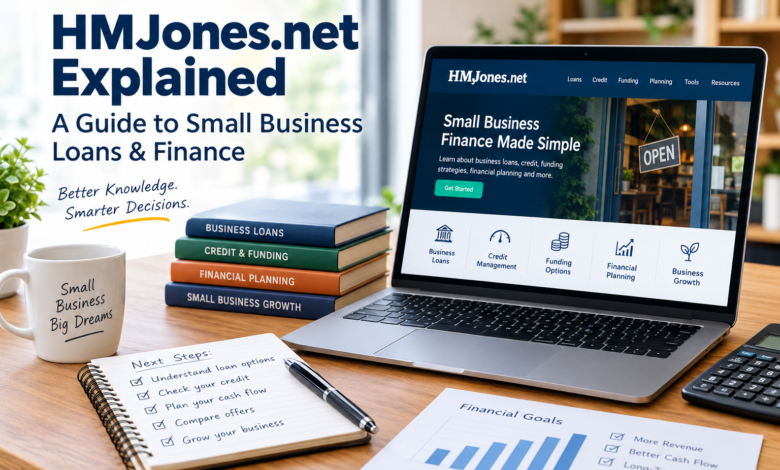
HMJones.net describes itself as a business-finance resource focused on helping entrepreneurs and small-business owners understand loans, credit management, funding strategies, financial planning, and financial tools.
But there’s an important distinction to keep in mind: an educational website can help you understand financing without being the company that actually approves or provides your loan.
So, let’s look at what HMJones.net covers, how small-business financing works, and what I would check before taking on any business debt.
What Is HMJones.net?
HMJones.net is an online resource centered on small-business finance.
Its current homepage covers several areas, including:
- Business loans
- Business credit
- Funding options
- Financial planning
- Cash-flow management
- Business growth
- Financial tools
- Entrepreneur resources
The site is aimed at people who may be starting a company, running an existing small business, or simply trying to understand financial decisions more clearly.
That makes its role different from a traditional bank.
A bank or other lender evaluates an application and decides whether to provide financing under its own requirements. A finance-information website, by contrast, can help you understand terminology and questions to ask before you apply.
That distinction matters because reading about a loan is not the same thing as being approved for one.
Why Small Businesses Look for Financing
There are many legitimate reasons a business might need additional capital.
Imagine a small online store that has started getting more orders. Sales are increasing, but the owner needs to purchase inventory before receiving payment from customers.
Or consider a local service company that has an opportunity to expand but needs another vehicle or specialized equipment.
In situations like these, financing can potentially help bridge the gap between today’s expenses and tomorrow’s revenue.
The SBA lists several common uses for business financing, including working capital, equipment, supplies, real estate, business expansion, and certain debt-refinancing purposes depending on the program.
The important part is matching the financing to the actual business need.
Borrowing money simply because it is available can create unnecessary pressure. Borrowing a specific amount for a clearly defined purpose gives you a much better basis for calculating whether the debt makes sense.
Understanding the Main Types of Business Financing
One of the most useful things to understand before applying for funding is that “business loan” is a broad term.
Different products work differently.
Traditional Business Loans
A traditional business loan generally provides a specific amount of money that is repaid according to an agreed schedule.
Banks and other financial institutions may look at factors such as business finances, credit history, repayment ability, collateral, and the purpose of the funding.
The exact requirements vary by lender.
For example, SBA-backed financing has specific eligibility requirements, and individual lenders still make lending decisions under the relevant program rules.
Business Lines of Credit
A business line of credit is different from receiving one large lump sum.
Instead, a business may have access to a predetermined credit limit and draw funds when needed, subject to the provider’s terms.
This can be useful when expenses fluctuate.
For example, a business that experiences seasonal demand may need additional working capital during certain months rather than taking a large long-term loan.
But flexibility does not mean free money. Interest, fees, repayment requirements, and other conditions need to be understood before using the facility.
Equipment Financing
Equipment financing is designed around purchasing business equipment.
That might include machinery, computers, commercial appliances, vehicles, or other qualifying assets depending on the financing provider.
The attraction is fairly straightforward: instead of paying the entire purchase price immediately, the business spreads the cost according to the financing agreement.
Before choosing this option, I would compare the total financing cost with the equipment’s expected useful life and the additional revenue or efficiency it is expected to create.
Microloans
For smaller funding requirements, microloans can be worth investigating.
The SBA’s current Microloan program provides loans of up to $50,000 through approved intermediary lenders. The funds can be used for purposes such as working capital, inventory, supplies, furniture, fixtures, machinery, and equipment, subject to program restrictions.
This is a good example of why understanding the exact financing program matters. Two products can both be called “business loans” while having very different limits, requirements, and permitted uses.
Business Credit Matters More Than Many Owners Expect
A common mistake is focusing entirely on revenue.
Revenue matters, obviously, but lenders may also care about credit history and other evidence that a business can responsibly handle debt.
HMJones.net highlights several credit-management practices, including paying bills on time, monitoring credit reports, maintaining responsible borrowing habits, and separating personal and business finances.
One practical lesson here is to start organizing your financial records before you need money.
Waiting until an emergency to gather bank statements, accounting records, tax documents, and other paperwork can make the process much more stressful.
Good records also make it easier for you—not just the lender—to understand how your business is performing.
Cash Flow Can Be More Important Than Profit on Paper
This is one of the easiest concepts to overlook.
A business can show a profit and still experience a cash-flow problem.
Suppose you invoice customers for $20,000 this month, but those customers have 30- or 60-day payment terms. Meanwhile, your business needs to pay suppliers, employees, rent, and other expenses this week.
The accounting numbers may look healthy while the bank balance feels uncomfortable.
HMJones.net specifically discusses cash-flow management and recommends practices such as tracking income and expenses, budgeting, planning for future costs, maintaining reserves, and improving payment cycles.
For a small business, a simple monthly cash-flow forecast can be surprisingly useful.
You don’t need a complicated financial model.
Start with:
Opening cash + expected money in − expected money out = estimated closing cash
Then repeat the calculation for each month.
This can reveal a funding gap before it becomes an emergency.
How to Prepare Before Applying for a Business Loan
If you’re considering financing, don’t start by filling out applications everywhere.
Start with the numbers.
Step 1: Decide Exactly How Much You Need
Avoid choosing an arbitrary round number.
If you need $28,000 for equipment and installation, work from the actual cost rather than automatically requesting $50,000.
Borrowing more than necessary can increase your repayment burden.
Step 2: Explain What the Money Will Do
A lender is likely to want to understand why you’re borrowing.
Instead of saying:
“I need money to grow.”
Be more specific:
“I need $25,000 for equipment that will increase production capacity by approximately X units per month.”
The second explanation gives everyone a clearer business case.
The SBA similarly recommends knowing the amount needed and how the funds will be used before approaching lenders.
Step 3: Review Your Financial Records
Gather relevant documents before applying.
Depending on the lender and situation, this may include:
- Business bank statements
- Income statements
- Balance sheets
- Tax records
- Accounts receivable information
- Existing debt details
- Business registration documents
- Financial projections
Not every lender will request the same information, so check the specific requirements.
Step 4: Calculate Your Repayment Capacity
This is the part I would never skip.
Don’t ask only:
“Can I get this loan?”
Ask:
“Can my business comfortably make these payments if sales are lower than expected?”
Build a conservative scenario.
If your expected monthly cash flow is $8,000, don’t automatically assume every month will produce $8,000.
Test what happens if revenue falls, expenses increase, or customers pay late.
Step 5: Compare the Full Cost
A low-looking rate does not necessarily tell you the whole story.
Look at:
- Interest rate
- Fees
- Repayment period
- Payment frequency
- Collateral requirements
- Personal guarantees
- Prepayment terms
- Late-payment consequences
- Total repayment amount
The FTC advises small businesses to study financing offers carefully and ask questions about guarantees, missed payments, and other contractual terms before signing.
Don’t Compare Loans by Monthly Payment Alone
This is a mistake that can make an expensive loan appear attractive.
Imagine two hypothetical offers:
Offer A: $30,000 with a shorter repayment period.
Offer B: $30,000 with a longer repayment period and lower monthly payments.
Offer B may feel easier because the monthly payment is smaller.
But a longer repayment period can mean paying more overall.
That’s why I prefer looking at the complete cost of borrowing rather than focusing on one attractive number.
Ask the lender to explain the total amount you will repay under the agreement.
If you don’t understand something, get the explanation in writing.
Be Careful With Online Financing Offers
Searching for financing online is convenient, but convenience can create another problem: it becomes difficult to distinguish legitimate financing providers from misleading offers.
The FTC recommends researching financing companies carefully rather than trusting search results or unsolicited offers. It also warns businesses to investigate who they are dealing with before providing confidential financial information.
Some warning signs deserve immediate attention.
Be cautious if someone:
- Pressures you to act immediately
- Makes unusually broad promises
- Won’t clearly explain fees
- Requests sensitive information before you establish who they are
- Refuses to provide important terms in writing
- Insists on unusual payment methods
- Avoids explaining repayment conditions
The FTC has also taken enforcement action in business-financing cases involving allegations of deceptive marketing and undisclosed costs, showing why reading the actual agreement matters rather than relying only on promotional language.
Where HMJones.net Fits Into the Process
This is where I think the distinction between education and lending becomes especially useful.
You can use a resource such as HMJones.net to become familiar with concepts like:
Loans → Credit → Funding → Cash Flow → Financial Planning → Business Growth
Then take that knowledge to an actual lender, accountant, financial professional, or relevant business-support organization.
HMJones.net itself covers these areas as part of its small-business finance focus.
Think of the website as part of your research process—not as a replacement for reviewing the actual terms of a financial product.
A Simple Example: A Growing Small Business
Imagine a small catering company that has been operating for two years.
It has regular customers and wants to purchase commercial equipment costing $18,000.
Before borrowing, the owner could work through five questions:
- How much cash does the business already have?
- Is the equipment genuinely necessary?
- How much additional revenue or cost savings could it produce?
- What monthly payment could the business comfortably handle?
- What happens if revenue drops for three months?
The answers might show that financing is reasonable—or they might reveal that purchasing the equipment now would put too much pressure on cash flow.
Either result is useful.
The goal isn’t to borrow money.
The goal is to make a financially informed decision.
Financial Tools Can Make This Easier
You don’t need an expensive financial system to start organizing business finances.
Depending on the size and type of business, owners may use accounting and bookkeeping software, spreadsheets, invoicing systems, banking dashboards, and expense-tracking applications.
The important thing is consistency.
Track:
- Revenue
- Operating expenses
- Outstanding invoices
- Existing debt
- Upcoming payments
- Cash reserves
- Taxes
- Major planned purchases
HMJones.net also highlights accounting, budgeting, expense tracking, invoicing, payroll, and financial reporting as areas where modern financial tools can help businesses gain better visibility.
The software itself isn’t the solution. The useful part is having reliable numbers available when you need to make a decision.
Common Mistakes to Avoid
Borrowing Without a Clear Purpose
“I might need the money later” isn’t a strong financing strategy.
Know what the capital is intended to accomplish.
Ignoring Cash Flow
A profitable business can still struggle to make payments if cash arrives too slowly.
Looking Only at the Interest Rate
Fees, repayment length, payment frequency, guarantees, and total repayment can change the real cost.
Applying Everywhere at Once
Research providers and understand their requirements before submitting applications.
Mixing Personal and Business Finances
Keeping business and personal transactions separate makes financial records easier to understand and can simplify business administration.
Signing Before Reading the Agreement
Never rely solely on what a salesperson says.
Read the contract and ask questions about anything unclear.
Trusting an Unsolicited Loan Offer
Unexpected financing messages deserve extra scrutiny. The FTC specifically warns businesses about unsolicited offers and advises verifying who is behind a financing opportunity before providing sensitive information.
Questions to Ask Before Taking Financing
Before accepting an offer, I’d make a short checklist:
How much will I actually receive?
How much will I repay in total?
What fees are charged?
How often are payments due?
Is a personal guarantee required?
Is collateral required?
What happens if I miss a payment?
Can I repay early, and are there charges?
What happens if my revenue falls temporarily?
Does the financing agreement restrict how I use the funds?
If the answers aren’t clear, don’t rush.
A lender should be able to explain the terms of its own product clearly.
Final Thoughts
The most useful lesson I’ve found when looking at small-business finance is that getting access to money isn’t the same as making a good financial decision.
A loan can help a business purchase equipment, manage working capital, or pursue an expansion opportunity. It can also create pressure if the repayment schedule doesn’t match the company’s cash flow.
That’s why understanding the basics matters.
HMJones.net provides an accessible starting point for learning about business loans, credit, funding strategies, financial planning, and financial tools.
From there, the smart next step is to check the actual numbers, compare financing terms, verify the lender, and consider whether the proposed borrowing fits the business’s ability to repay.
For a small-business owner, that extra preparation can be just as valuable as finding the funding itself.
FAQs
Is HMJones.net a business lender?
HMJones.net describes itself as an online business-finance resource covering loans, credit, funding strategies, financial planning, and related topics. Its homepage does not present it as a bank or direct lender.
What can I learn from HMJones.net?
The site covers subjects including business loans, credit management, funding options, cash flow, financial planning, financial tools, and business growth strategies.
What should I know before applying for a business loan?
Start by understanding how much you need, what the money will be used for, whether your business can comfortably repay it, and what the complete financing cost will be. The SBA recommends preparing information about the amount and use of funds, business finances, and credit before approaching lenders.
Are all business loans the same?
No. Traditional loans, lines of credit, equipment financing, microloans, and other funding products can have different purposes, costs, eligibility requirements, and repayment structures.
Is online business financing safe?
Online financing can be legitimate, but businesses should verify the provider and carefully review the offer. The FTC recommends researching financing companies, protecting sensitive information, and understanding the complete agreement before committing.
