
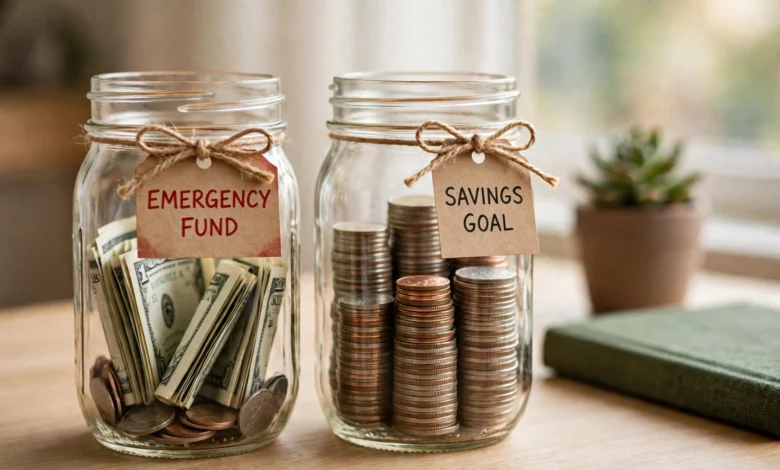
An emergency fund and a savings account are not the same thing, even though they often live in the same place. An emergency fund is a purpose: money set aside only for unexpected problems, such as losing a job, a medical bill, or a major car repair. A savings account is a place: a bank account where you keep money for planned goals, such as a holiday, a wedding, or a house deposit.
That is the whole difference in one line. The emergency fund is about why the money exists. The savings account is about where the money sits. In fact, most emergency funds are kept inside a savings account, usually a separate high-yield savings account, so the two ideas overlap. The trouble starts when the money is mixed together in one pot, because then a holiday can quietly eat the money you needed for a broken car.
This guide explains the difference in plain English: what each one is, how much to keep in each, where the money should live, and how to build both at once.
What Is an Emergency Fund?
An emergency fund is a dedicated cash reserve with one job: to cover urgent, unplanned expenses that would otherwise force you into debt. It is the money you reach for when life goes wrong, not when life offers a nice opportunity.
A real emergency is something unexpected, urgent, and necessary: losing your job and needing to pay rent, a medical bill you did not see coming, a car breakdown that stops you getting to work, or a burst pipe flooding your kitchen.
A holiday is not an emergency. A sale on a new television, a wedding gift, or a new phone because you fancy an upgrade are not emergencies, even if they feel urgent in the moment. If you spend the emergency fund on those things, it is not there when a real problem arrives, and that is exactly how a small surprise turns into credit card debt.
The emergency fund is also not an investment. Its job is not to grow fast. Its job is to be there, in full, on the day you need it, which is why it stays in cash, in a safe, easy-to-reach account, and not in stocks or crypto.
How much should be in an emergency fund?
The standard target is three to six months of essential expenses: the bills you must pay to keep life running, such as rent or mortgage, utilities, groceries, transport, insurance, and minimum debt payments. It is not three to six months of your income, or of everything you spend including eating out and streaming. It is the cost of the basics.
Take a household that spends $3,000 a month on essentials. Three months of cover is $9,000. Six months is $18,000. A single person with a steady job can aim for the lower end, while a family with one income, or someone whose work is seasonal or freelance, should aim for the higher end.
That number can look frightening, so start smaller. A starter fund of $1,000 covers most small surprises: a car repair, a broken appliance, a vet bill. Once that is in place, keep going toward one month of expenses, then three, then six. It does not need to be finished in a month; it needs to be started.
The Federal Reserve’s 2024 report on household well-being found that only 63% of US adults would cover a hypothetical $400 emergency using cash or its equivalent. For many people, even a small surprise becomes a debt, and the emergency fund is what stops that happening.
What Is a Savings Account?
A savings account is a bank account for money you are deliberately setting aside. Unlike the emergency fund, which is defined by its purpose, a savings account is defined by the account itself: it holds money, pays some interest, and lets you take it out when you need it.
People use savings accounts for planned goals: a holiday in six months, a wedding next year, a house deposit in three years, a new car when the old one finally gives up. The amount is whatever the goal costs, and the timing is whenever the goal arrives. There is no fixed rule like the three-to-six-months target, because every goal is different.
A regular savings account at a traditional bank pays very little interest, often well under 1% a year. A high-yield savings account pays much more, because online banks have lower costs and pass some of that saving on. The money is still easy to reach and still protected up to the usual deposit insurance limits, but it earns more while it waits, which is why a high-yield account is the natural home for both an emergency fund and goal savings.
It helps to understand how a high-yield savings account pays more interest than a regular one before choosing where to keep your savings.
A third kind of saving also lives in savings accounts: the sinking fund, money set aside in small regular amounts for an expense you know is coming but cannot cover from one paycheck, such as annual car insurance, holiday gifts, or new tyres.
Emergency Fund vs Savings Account: The Difference at a Glance
| Feature | Emergency fund | Savings account (goal savings) |
|---|---|---|
| What it is | A purpose: money for unexpected crises | A place: a bank account for planned goals |
| What it pays for | Job loss, medical bills, major car repairs | Holidays, weddings, house deposits, new cars |
| Target amount | 3 to 6 months of essential expenses | Whatever the goal costs |
| When you use it | Only in a real emergency | When you reach the goal |
| How often you withdraw | Rarely, and only in a crisis | When the goal arrives |
| Best place to keep it | Separate high-yield savings account | High-yield savings account, separate from the emergency fund |
| What matters most | Liquidity and safety: reachable in a day or two | Earning interest while the goal is still ahead |
The emergency fund and the savings account are not rivals. They are two different jobs, and the same kind of account can do both, as long as the money is kept apart.
Emergency Fund vs Savings vs Sinking Fund
There is a third bucket that causes confusion: the sinking fund. It is not an emergency fund and not quite a savings account either. It sits in between.
| Feature | Emergency fund | Savings account | Sinking fund |
|---|---|---|---|
| Purpose | Unexpected crises | Planned goals | Predictable irregular costs |
| Examples | Job loss, medical bill, major breakdown | Holiday, wedding, house deposit | Annual insurance, holiday gifts, new tyres |
| Target amount | 3 to 6 months of essential expenses | Cost of the goal | Total cost divided by the months until it is due |
| When to use it | Only in a true emergency | When the goal is reached | When the planned expense arrives |
| How often you withdraw | Rarely, ideally never | When a goal is met | Regularly, as planned expenses come due |
| Replenishment | Top priority after any withdrawal | Start a new goal | Ongoing, refills automatically |
Think of it this way: the emergency fund protects you from the unknown, the savings account funds what you are working toward, and the sinking fund prepares you for what you know is coming. All three are easier when they are kept in separate accounts or sub-accounts.
You may also like:
| Related Article |
|---|
| How to Open a High-Yield Savings Account With $100 in 2026 |
| APR vs APY: What Is the Difference and Which One Matters More? |
Where to Keep Each One
Where the money lives matters almost as much as how much there is. The emergency fund needs two things above all: it must be reachable fast, and it must be safe. Reachable means you can withdraw it within a day or two, with no penalty. Safe means its value does not fall. A high-yield savings account meets both tests, which is why it is the standard recommendation.
A checking account also meets the reachability test, but it fails in a different way: the money is too easy to spend. If the emergency fund sits in the same account as your daily spending, a takeaway or a sale can eat into it without you noticing. Keep the emergency fund in its own account, at a different bank if that helps, so spending it takes a deliberate transfer rather than a thoughtless tap.
Goal savings can live in the same kind of account, but in a separate pot. Many online banks let you open several savings accounts, or split one account into named sub-accounts, at no extra cost. Name them after the goal, such as “Holiday” or “House deposit”, so the money is harder to spend on something else.
Do not keep the emergency fund in investments. Stocks, funds, and crypto can fall in value, often fastest exactly when jobs are at risk, and selling can take days. Investments are for money you will not need for years. The emergency fund is for money you might need next week.
The interest rate matters, but it is not the point. A fund that earns a little less but is always there beats a fund that earns more but is locked away or at risk. Learn what APY means for the interest your savings earn so you can compare accounts fairly.
Can One Account Serve Both?
Technically, yes. One savings account can hold both your emergency money and your goal money, because the bank does not care what the money is for. But in practice, it is a bad idea for most people, for one simple reason: money without a label gets spent.
When the emergency fund and the holiday fund share one balance, the balance looks bigger than it is. A $12,000 balance feels comfortable, but if $9,000 of it is the emergency fund and only $3,000 is for the holiday, spending $5,000 on the holiday quietly takes $2,000 from the emergency fund.
Separate accounts fix this without any extra effort. The emergency fund has its own balance, its own name, and its own job, and the goal savings have their own balances too. You always know exactly where you stand, and a withdrawal from one cannot silently eat the other.
There is one exception. If you are just starting out and your total savings are a few hundred dollars, splitting them across three accounts is more confusing than helpful. Keep one account, but note how much of the balance belongs to each purpose. Once the total passes $1,000, split it into separate accounts.
How to Build Both at the Same Time
The most common question after the difference is clear is: which one do I build first? The answer is the emergency fund, but not to the exclusion of everything else.
Start with a starter emergency fund of $1,000. Put all of your monthly saving toward it until it is done, which usually takes a few months, then split your monthly saving between the emergency fund and your goals.
Here is a worked example. Suppose you can save $500 a month. Put $350 a month into the emergency fund and $150 a month toward your goals. If your essential expenses are $3,000 a month, your full emergency fund target is $9,000 for three months. At $350 a month, that takes about 26 months, and the starter $1,000 was already there from the beginning. Once the emergency fund is full, the whole $500 a month goes to your goals.
If $500 a month is more than you can save, the same split works at any size. At $300 a month, put $200 toward the emergency fund and $100 toward goals. At $100 a month, put $70 toward the emergency fund and $30 toward goals. The amounts matter less than the habit: a fixed transfer on payday, every month, before the money can be spent. It also helps to set aside money every month automatically, so the saving happens even in a busy month.
While you are building, keep the emergency fund ahead of the goals. A holiday can wait a month. A broken car cannot. Once the fund reaches three months of expenses, tilt the split toward goals until it reaches six months. After that, all of your saving can go to goals.
Common Mistakes to Avoid
The first mistake is using the emergency fund for something that is not an emergency. A holiday, a sale, or a new phone are all tempting, and the money is right there. But every withdrawal for a non-emergency is a hole in your safety net, always discovered at the worst moment. If you are not sure whether something counts, ask: would this force me into debt if I did not have the fund? If the answer is no, it is not an emergency.
The second mistake is keeping the emergency fund in a checking account. The money is reachable, but it is also spendable without thinking. A separate savings account adds just enough friction to stop casual spending while still letting you reach the money in a day or two.
The third mistake is keeping the emergency fund in investments. Stocks and crypto can drop sharply, often at the same time as job losses rise, and selling in a crisis means selling at a loss and waiting days for the money. The emergency fund belongs in cash, where its value never falls.
The fourth mistake is saving for goals before having any emergency cushion at all. If a $400 car repair lands while you have no emergency fund, the repair goes on a credit card, and the interest costs more than the holiday was worth. Build the starter $1,000 first.
The fifth mistake is never replenishing the fund after using it. After a real emergency, make refilling the fund your top saving priority, before any new goal. A fund that is empty after one crisis is no fund at all.
The sixth mistake is setting the target once and forgetting it. Essential expenses change: rent goes up, a child arrives, a car is replaced. Check the target once a year by adding up a month of essential expenses and multiplying by three and by six.
Keep a separate emergency cushion of your own before taking on any borrowing, so a broken car or a medical bill does not force you into a loan at the worst possible time.
You may also like:
| Related Article |
|---|
| Installment Loans Explained: How They Work, Types and Costs 2026 |
| Beginner Investment Guide: How to Start Investing with Confidence |
Conclusion
An emergency fund and a savings account are different things that work best together. The emergency fund is a purpose: money set aside only for unexpected problems, sized at three to six months of essential expenses, kept in a separate high-yield savings account where it is safe and reachable. The savings account is a place: a bank account for planned goals, sized by whatever the goal costs, kept in its own pot.
The difference is not about the account. It is about the job the money does. Keep the two jobs separate, build the starter $1,000 first, then split your monthly saving between the fund and your goals. Done that way, a surprise stays a surprise, instead of becoming a debt.
Start today, even with a small amount. Open a separate high-yield savings account, name it “Emergency Fund”, and set up an automatic transfer for payday.
FAQs
What is the difference between an emergency fund and a savings account?
An emergency fund is a purpose: money set aside only for unexpected crises, such as job loss or a medical bill. A savings account is a place: a bank account where you keep money for planned goals, such as a holiday or a house deposit. Most emergency funds are kept inside a savings account, but separate from goal savings.
Can my emergency fund be in a savings account?
Yes, and it should be. A separate high-yield savings account is the usual home for an emergency fund, because the money is safe, earns interest, and can be withdrawn within a day or two.
How much should I have in an emergency fund?
The standard target is three to six months of essential expenses. If your essential spending is $3,000 a month, that is $9,000 to $18,000. Start with $1,000, then build to one month, then three, then six.
Should I save for a goal or build an emergency fund first?
Build the emergency fund first, starting with $1,000. Once that is in place, split your monthly saving between the emergency fund and your goals. A holiday can wait a month, but a broken car or a medical bill cannot.
Can I use my emergency fund for a holiday?
No. A holiday is a planned goal, not an emergency, so it should come from goal savings. Using the fund for a holiday leaves a hole in your safety net, usually discovered when a real emergency arrives.
What is a sinking fund, and is it the same as an emergency fund?
No. A sinking fund is money set aside in small regular amounts for a predictable expense you know is coming, such as annual car insurance or holiday gifts. An emergency fund is for unexpected crises you cannot predict. Both work best in their own separate pots.