
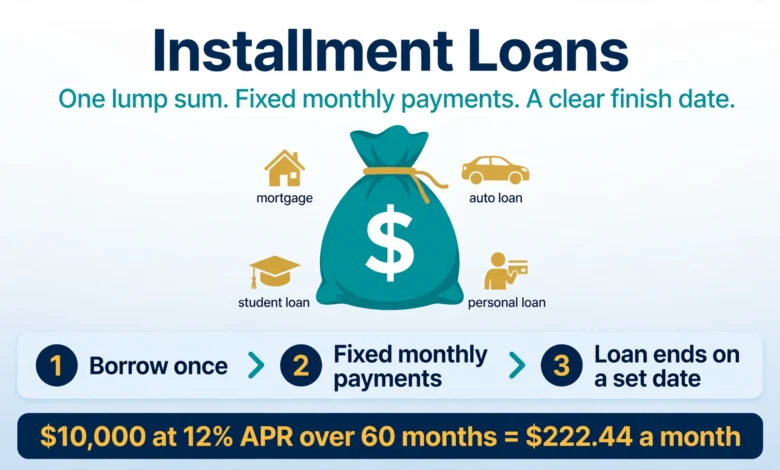
An installment loan is a loan you borrow once, as a single lump sum, and repay in fixed, regular payments over a set period of time. If you borrow $10,000 at 12% APR over 60 months, you pay about $222.44 every month for five years, and when the last payment is made the loan is finished and the account closes.
That fixed payment is the whole point. You know exactly what leaves your account each month, and you know the exact date the loan ends. A mortgage, a car loan, a student loan and most personal loans all work this way.
This guide explains installment loans in plain English: what they are, how the monthly payment is worked out, the main types, what they cost, how they differ from a credit card, and how to get one. All numbers below are worked examples, not live offers.
What Is an Installment Loan?
An installment loan is a loan for a fixed amount, repaid in a fixed number of scheduled payments, called installments, over a fixed term. You receive the money once, usually as a lump sum paid into your bank account, and repay it in equal monthly payments until the balance reaches zero.
Each monthly payment covers two things: the interest charged on the balance you still owe, and a slice of the original amount you borrowed, called the principal. Early in the loan, a larger share of each payment goes to interest, because the balance is at its highest. Later, as the balance falls, more of each payment goes to the principal. The payment itself stays the same every month, as long as the rate is fixed.
Installment loans at a glance
| Question | Short answer |
|---|---|
| What do you get? | One lump sum, paid once |
| How do you repay it? | Fixed monthly payments, same amount every month |
| How long does it last? | A few months to 30 years, depending on the type |
| What does it cost? | Interest (APR) plus any fees, such as an origination fee |
| Can you borrow more from it? | No – you would need a new loan |
| Common examples | Personal loan, auto loan, mortgage, student loan, buy now, pay later |
How Installment Loans Work
An installment loan works in four steps, and they are the same for almost every type. First, you apply for a fixed amount, and the lender checks your credit score, your income, and your debts. Second, you receive the money as a lump sum, usually within one to five business days of approval. Third, you repay it in fixed monthly payments, starting about 30 days after you receive the funds. Fourth, the loan closes when you make the final payment.
The monthly payment is set on day one, using a formula called amortisation. It works out the payment that will clear the balance exactly by the end of the term, if you pay on time every month. A longer term always means more total interest, even though the monthly payment is lower.
Why the interest share falls over time
Interest is charged on the balance you still owe, so it is highest at the start. Take $10,000 at 12% APR over 60 months, with a fixed payment of $222.44 a month. In the first month, the interest is $10,000 times 1% (one twelfth of 12%), which is $100.00. That leaves $122.44 to reduce the principal, so the balance falls to $9,877.56. By the final month, the balance is only about $220, so the interest is only about $2.20, and almost the whole payment goes to the principal.
What the lender must tell you before you sign
In the United States, installment loans are closed-end credit under the Truth in Lending Act, carried out through Regulation Z. Before you commit, the lender must show you the amount financed, the finance charge, the annual percentage rate (APR), the total of all payments, and whether there is a penalty for paying the loan off early. If a lender will not show you those numbers in writing, do not sign.
If you are comparing loan costs, it helps to understand how APR is calculated on a loan, because the APR includes both the interest rate and most of the fees, so it is the fairest way to compare two offers.
Types of Installment Loans
Any loan with a set amount, a set schedule and an end date is an installment loan. These are the ones you are most likely to meet.
| Type | Typical term | Secured? | What to watch |
|---|---|---|---|
| Personal loan | 2 to 7 years | Usually not | Origination fees and a wide APR range |
| Auto loan | Often 5 to 6 years | Yes, by the car | A longer term costs more interest and can leave you owing more than the car is worth |
| Mortgage | 15 or 30 years | Yes, by the home | An adjustable rate can raise the payment later |
| Student loan | 10 to 25 years | No | Interest can keep growing during deferment |
| Buy now, pay later | 6 weeks to 24 months | No | Late fees, and short 0% offers that turn expensive |
A personal loan is the most flexible type. You can use it for almost any reason, and the amounts usually run from $1,000 to $100,000. Because there is no collateral, the rate depends heavily on your credit, and personal loan APRs often run from about 6% to 36%.
An auto loan is secured by the car you are buying, and a mortgage is secured by the home. That security is why their rates are usually lower than a personal loan: if you stop paying, the lender can take the car or foreclose on the home.
Buy now, pay later is the newest type. At checkout you split a purchase into equal payments, often four over six to eight weeks, sometimes with no interest. It is the same structure, and missing a payment can mean late fees and a mark on your credit report.
You may also like:
| Related Article |
|---|
| How to Open a High-Yield Savings Account With $100 in 2026 |
| APR vs APY: What Is the Difference and Which One Matters More? |
Secured vs Unsecured Installment Loans
The difference is collateral: something of value the lender can take if you do not repay. A secured installment loan is backed by an asset. A mortgage is secured by the home, an auto loan by the car, and a secured personal loan by a savings account or another asset. Because the lender has something to fall back on, secured loans usually have lower rates, larger amounts, and longer terms, and they are easier to get with a lower credit score.
An unsecured installment loan has no collateral. Most personal loans, student loans and buy now, pay later plans are unsecured. Approval is based mainly on your credit score, your income and your debts, so the rates are higher and the amounts are smaller.
Neither type is always better. A secured loan is cheaper, but you risk losing the asset. An unsecured loan costs more, but nothing specific is on the line. A home or a car is not a good thing to risk for a holiday or a short-term want.
Installment Loans vs Revolving Credit
Installment loans and revolving credit are the two basic ways to borrow, and they work in opposite ways.
| Feature | Installment loan | Revolving credit |
|---|---|---|
| How you borrow | One lump sum, once | Up to a credit limit, again and again |
| Payments | Fixed, same amount every month | Minimum payment that rises and falls with your balance |
| End date | Fixed – the loan ends on a set date | None – it stays open as long as you use it |
| Interest | Usually fixed, on the full amount borrowed | Usually variable, only on the balance you carry |
| Examples | Personal loan, mortgage, auto loan | Credit card, home equity line of credit (HELOC) |
A credit card is useful for small, short-term spending that you pay off quickly. An installment loan is better for a large, one-off cost that you want to repay over a known period, such as a car or a home repair. The danger with revolving credit is that there is no end date: if you only pay the minimum, a small balance can last for years. The danger with an installment loan is the opposite: the payment is fixed, so if your income falls, you cannot reduce it without refinancing or asking the lender for help.
Worked Examples: What an Installment Loan Really Costs
The monthly payment looks small, but the total interest is what matters. The tables below are worked examples, not live offers.
Example 1: $10,000 at different rates over 60 months
| APR | Monthly payment | Total repaid | Total interest |
|---|---|---|---|
| 8% | $202.76 | $12,165.84 | $2,165.84 |
| 12% | $222.44 | $13,346.67 | $3,346.67 |
| 18% | $253.93 | $15,236.06 | $5,236.06 |
| 24% | $287.68 | $17,260.78 | $7,260.78 |
The same $10,000 costs $2,165.84 in interest at 8% and $7,260.78 at 24% – more than three times as much. The monthly payment only rises from $202.76 to $287.68, so the true cost is easy to miss if you only look at the monthly figure.
Example 2: a shorter term costs less overall
Borrow $10,000 at 12% APR over 36 months instead of 60 months, and the payment rises to $332.14 a month, but the total interest is only $1,957.15 – about $1,390 less than the 60-month loan. A shorter term means a higher monthly payment and less total interest.
Example 3: a smaller loan
Borrow $5,000 at 12% APR over 36 months, and the payment is $166.07 a month. The total repaid is $5,978.58, so the total interest is $978.58 – almost 20% of the amount borrowed. Even a small installment loan deserves a comparison.
What an Installment Loan Costs
The cost of an installment loan is more than the interest rate. The APR is the best single number to compare, because it includes the interest rate plus most of the fees.
An origination fee is charged by some personal loan lenders, usually 1% to 8% of the loan amount, and it is often taken out of the lump sum before you receive it. A $10,000 loan with a 5% origination fee means you only receive $9,500, but you still repay $10,000 plus interest. A late payment fee applies if you miss the due date, and some loans charge a prepayment penalty if you pay the loan off early – always ask about this before you sign.
The rate itself depends on the loan type and your credit. Personal loan APRs often run from about 6% to 36%, with the lowest rates going to borrowers with strong credit and steady income. A secured loan, such as an auto loan or a mortgage, usually costs less than an unsecured personal loan for the same borrower. Rates change often, so the numbers in this article are ranges reported by lending guides, not offers.
For a very different kind of borrowing, where the lender is a person rather than a bank, see a private money loan for a real estate deal – it is faster, but it costs far more than a standard installment loan.
How to Get an Installment Loan
Getting an installment loan is straightforward, but a little preparation can save you hundreds of dollars in interest.
First, check your credit report and your credit score. Borrowers with good or excellent credit, usually scores in the mid-600s or higher, are more likely to be approved and to get lower rates. If you find an error on your report, dispute it before you apply.
Second, work out how much you actually need, and how much you can pay each month. Borrow only what the purchase requires, not the maximum the lender offers.
Third, compare at least three lenders: a bank, a credit union, and an online lender. Compare the APR, the total interest, the fees, and the term – not just the monthly payment. Many lenders let you check your rate with a soft credit inquiry, which does not affect your score, so use that before you apply formally.
Fourth, gather your documents: proof of identity, proof of income, and details of your existing debts. Fifth, apply, and read the loan agreement before you sign it. Check the APR, the monthly payment, the total of payments, the fees, and whether there is a prepayment penalty. If anything is different from what you were told, stop and ask.
Before you sign, check: is the APR competitive, is there an origination fee, is there a prepayment penalty, is the payment affordable even in a bad month, and is the term the shortest you can afford?
How Installment Loans Affect Your Credit
An installment loan affects your credit in both directions, and the effect depends on how you handle it.
When you apply, the lender usually makes a hard inquiry on your credit report, which can lower your score by a few points for a short time. Checking your own rate with a soft inquiry does not do this. Once the loan is open, it adds to your credit mix – the variety of credit types on your report – which can help your score a little.
The biggest effect comes from your payments. Every on-time payment builds your history, and a long record of on-time payments is the strongest part of a credit score. A late payment, usually reported after 30 days, damages your score, and a default stays on your report for years. The loan also raises your total debt, which can make it harder to borrow again until the balance falls.
If you are struggling, talk to the lender before you miss a payment. Many lenders will offer a short pause, a smaller payment for a few months, or a new term – but they can only help if you ask early.
Pros and Cons of Installment Loans
The main advantage is predictability. The payment is fixed, the end date is fixed, and you know the total cost before you start. That makes budgeting easy, and it makes a large purchase manageable by spreading it over months or years. A second advantage is that installment loans can build credit, because a record of fixed on-time payments is exactly what credit scoring rewards. A third is that the rates are usually lower than a credit card, especially for secured loans such as a mortgage or an auto loan.
The disadvantages are just as real. First, you cannot borrow more from the same loan: if the repair costs more than you borrowed, you need a new loan. Second, the total interest can be large – a $10,000 loan at 24% over five years costs $7,260.78 in interest alone. Third, the fixed payment does not bend: if your income falls, the payment stays the same. Fourth, a secured installment loan puts an asset at risk – miss enough payments on a mortgage or an auto loan, and you can lose the home or the car.
Before you borrow, it helps to keep a separate emergency cushion of your own, so a broken car or a medical bill does not force you into a loan at the worst possible time.
Mistakes to Avoid, and the High-Interest Warning
The first mistake is borrowing more than you need. Lenders often approve more than you asked for, but every extra dollar costs interest for the full term. The second mistake is choosing the longest term just to get the lowest payment. A 7-year personal loan has a lower monthly payment than a 3-year loan, but it can cost twice as much interest in total.
The third mistake is ignoring the APR and comparing only the monthly payment. Two loans with the same payment can have very different total costs. The fourth mistake is taking a high-interest installment loan for something that is not urgent. Personal finance experts say 36% APR is the maximum an affordable unsecured loan can have – above that, the purchase should usually wait. At 36% APR, a $10,000 loan over 60 months would cost more than $11,000 in interest alone.
The fifth mistake is missing payments, because the damage to your credit lasts far longer than the loan. The sixth is not reading the agreement. It also helps to set aside money every month for the things you know are coming, so fewer of them turn into loans.
You may also like:
| Related Article |
|---|
| Private Money Lending: How It Works for Real Estate Investors 2026 |
| Beginner Investment Guide: How to Start Investing with Confidence |
Conclusion
An installment loan is the simplest way to borrow for a large, one-off cost: you get one lump sum, you pay the same amount every month, and you know the exact date the loan ends. That predictability is its greatest strength, and its greatest weakness is that the payment never bends, so it has to fit your budget in a bad month as well as a good one.
Use the APR, not the monthly payment, to compare offers, and always look at the total interest, not just the payment. Choose the shortest term you can afford, check for an origination fee and a prepayment penalty, and borrow only what the purchase actually needs. Done that way, an installment loan is a useful tool. Done in a hurry, at a high rate, for more than you need, it becomes an expensive habit.
Start by checking your credit score and working out what monthly payment you can truly afford. If the numbers work, compare at least three lenders and read the agreement before you sign. If they do not work, wait, save, and borrow less later.
FAQs
What is an installment loan in simple words?
An installment loan is a loan you borrow once as a lump sum and repay in fixed monthly payments over a set period, until the balance reaches zero. A personal loan, a car loan, a mortgage and a student loan are all installment loans.
Is an installment loan the same as a personal loan?
No. A personal loan is one type of installment loan. A mortgage, an auto loan and a student loan are also installment loans, because they all use the same structure: one lump sum, fixed payments, a set end date.
Are installment loans secured or unsecured?
Both exist. A mortgage and an auto loan are secured by the home or the car. Most personal loans, student loans and buy now, pay later plans are unsecured, which means no asset is pledged, but the rates are usually higher.
Do installment loans help build credit?
Yes, if you pay on time. On-time payments build your payment history, which is the biggest part of a credit score. Late or missed payments do the opposite, and the damage can last for years.
What credit score do I need for an installment loan?
There is no single minimum. Most lenders look for scores in the mid-600s or higher for their best rates, and some work with scores from around 580, but the rate will be higher.
Can I pay off an installment loan early?
Usually yes, and paying early saves interest, because interest is charged on the balance you still owe. But some loans charge a prepayment penalty, so always check the agreement before you pay extra.