
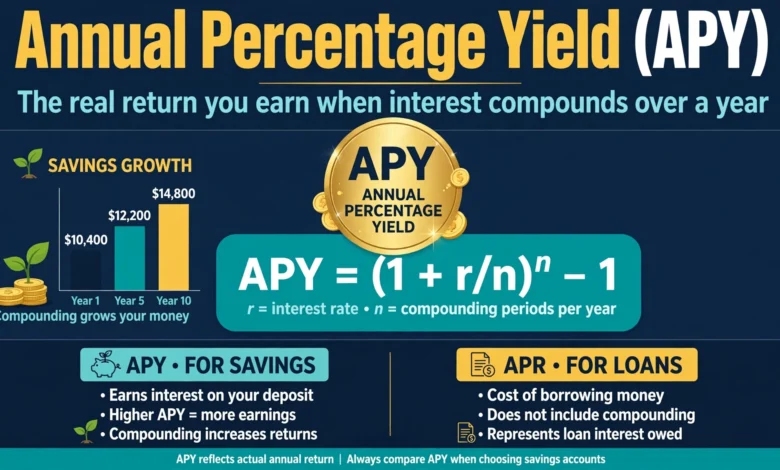
Annual percentage yield, or APY, is the number that tells you how much your savings will actually earn in one year, including compound interest. If a bank says its savings account pays 4.00% APY, that means $1,000 left alone for a full year will grow to about $1,040, as long as the rate does not change and you do not add or withdraw any money.
That one sentence is the whole idea. APY is a standard measure that banks in the United States must use, so you can compare two savings accounts on the same basis, even if one compounds daily and the other compounds monthly. Once you understand it, you can stop guessing which account is better and compare them in seconds.
This guide explains annual percentage yield in plain English: what APY means, how compounding works, how to calculate it, how much you can earn, where you see it, and how to use it to choose an account. All numbers below are worked examples, not live rates. Rates change often, so check the current rate before you open an account.
What Is Annual Percentage Yield?
Annual percentage yield is the yearly return you earn on money you keep in a deposit account, shown as a percentage. It is the rate you see on savings accounts, high-yield savings accounts, certificates of deposit, and money market accounts.
The key word is yield. APY does not just show the interest rate the bank pays. It shows what that rate turns into after a full year, once the interest you earn starts earning interest of its own. That step is called compounding, and it is why APY is almost always a little higher than the plain interest rate on the same account.
Think of it this way. A bank might pay a nominal interest rate of 4.00%, compounded monthly. Because each month’s interest is added to your balance and then earns interest in the next month, the real yearly result is about 4.07% APY. The APY tells you the honest yearly result, so you do not have to do the maths yourself.
APY at a glance
| Question | Short answer |
|---|---|
| What does APY stand for? | Annual Percentage Yield |
| What does it measure? | What you earn on savings in one year, including compounding |
| Where do you see it? | Savings accounts, high-yield savings accounts, CDs, money market accounts |
| Does it include compounding? | Yes |
| Does it include fees? | No |
| What do you want? | The highest number, with no monthly fee |
| What law requires it? | Truth in Savings Act 1991, Regulation DD |
That last row matters. In the United States, the Truth in Savings Act, carried out through Regulation DD, requires banks to disclose the annual percentage yield for deposit accounts, so savers can compare accounts fairly. If two banks show you APYs, you are comparing like with like.
How Compounding Makes APY Work
Compounding means earning interest on interest. It is a simple idea, and it is the whole reason APY exists.
Imagine you save $1,000 at 5% simple interest. It only pays interest on your original amount, so you earn $50 in the first year and $50 again in the second year.
Now imagine the same $1,000 at 5% compounded monthly. Each month’s interest is added to your balance, and the next month pays interest on that larger balance. By the end of the year, you have earned $51.16, not $50. The extra $1.16 is small on $1,000, but over five or ten years it becomes hundreds of dollars.
That is why APY is always equal to or higher than the nominal interest rate. The more often interest compounds, the higher the APY. But the gain is not endless. Most of the benefit comes from moving from annual compounding to monthly compounding. Moving from monthly to daily adds only a tiny amount, as you will see in the table below.
The APY Formula, Explained Simply
You do not need to memorise the formula to use APY well. But if you want to check a bank’s maths, this is the formula that connects them.
APY = (1 + r / n) ^ n – 1
In this formula, r is the nominal annual interest rate as a decimal, and n is the number of compounding periods in a year. If interest compounds monthly, n is 12. If it compounds daily, n is 365. If it compounds once a year, n is 1, and APY is exactly the same as the nominal rate.
Take a nominal rate of 5%, or 0.05 as a decimal, compounded monthly. Divide the rate by 12 (0.05 / 12 = 0.004167), add 1 (1.004167), raise it to the power of 12 (1.05116), and subtract 1. The answer is 0.05116, or 5.12% APY. So a 5% nominal rate compounded monthly is really 5.12% APY. On $1,000, that is $51.16 in a year, not $50.
How compounding frequency changes APY
The table below uses a 5% nominal rate and shows what happens as compounding gets more frequent. All figures are for $1,000 left alone for one full year.
| Compounding | n | APY on a 5% nominal rate | Interest on $1,000 in one year |
|---|---|---|---|
| Annually | 1 | 5.00% | $50.00 |
| Semi-annually | 2 | 5.06% | $50.63 |
| Quarterly | 4 | 5.09% | $50.95 |
| Monthly | 12 | 5.12% | $51.16 |
| Daily | 365 | 5.13% | $51.27 |
Three things are worth noticing. First, most of the gain comes from moving from annual to monthly compounding. Moving from monthly to daily adds only $0.11 on $1,000. Second, the gap grows as the rate grows. Third, when two accounts show the same APY, they will earn you the same amount in a year, even if one compounds daily and the other monthly. APY already accounts for that difference.
A 4% nominal rate compounded daily is 4.08% APY.
How Much Will You Earn at Different APYs?
The honest answer depends on your balance. On $100, even a good APY earns only a few dollars in a year. On $10,000, the difference between a regular savings account and a high-yield account is hundreds of dollars a year. The table below shows simple one-year interest on a single deposit left alone, using example APYs. It assumes the rate stays the same for a full year, which it rarely does. Use it as a guide, not a guarantee.
| Balance | At 0.39% APY (national average) | At 4.00% APY | At 5.00% APY |
|---|---|---|---|
| $100 | $0.39 | $4.00 | $5.00 |
| $1,000 | $3.90 | $40.00 | $50.00 |
| $5,000 | $19.50 | $200.00 | $250.00 |
| $10,000 | $39.00 | $400.00 | $500.00 |
On $100, the difference looks tiny. On $10,000, a 4.00% APY earns about $361 more in a year than the national average of 0.39%. That is why APY matters most once you have a real balance.
If you add money every month, the numbers change faster. Start with $100 and add $50 every month, and to set aside a little money every month is the simplest way to keep growing. At 4.00% APY, you would earn roughly $15 to $20 in interest in that first year. The habit is the engine. The APY is the boost.
Where You See APY
APY appears wherever you deposit money and earn interest. A regular savings account at a large bank may show less than 0.50% APY, against a national average of around 0.38% to 0.39%. A high-yield savings account from an online bank may show around 3.50% to 4.20% in 2026. Both are usually FDIC insured up to $250,000. The difference is the APY, and the difference in what you earn is large.
A certificate of deposit, or CD, also shows an APY, usually fixed for a set term such as one year. You leave the money alone for that term and usually earn a slightly higher APY, but you pay a penalty if you withdraw early. A money market account is similar to a savings account, sometimes with a debit card, and it also shows an APY, so compare the APY, not the account name.
APY also appears in crypto, for staking or lending a digital asset. The maths is the same, but the risk is very different: a bank account is usually FDIC insured up to $250,000, while a crypto yield is not insured, the token price can fall, and the rate can change quickly.
| You may also like: |
|---|
| How to Open a High-Yield Savings Account With $100 in 2026 |
| APR vs APY: What Is the Difference and Which One Matters More? |
Fixed APY vs Variable APY
Most savings accounts have a variable APY, so the bank can change the rate at any time. If the Federal Reserve raises or lowers interest rates, banks usually follow, and your APY moves with them. An account paying 4.20% APY today might pay 3.80% or 4.50% in six months.
A fixed APY is different. A certificate of deposit usually has a fixed APY for its term. If you open a one-year CD at 4.50% APY, that rate stays the same for the full year, even if rates fall. That certainty is useful if you want to lock in a rate, but it also means you cannot benefit if rates rise.
Neither type is always better. A variable APY is good when rates are rising. A fixed APY is good when rates are falling, because your rate is locked in. For money you need to reach at any time, such as an emergency fund, a variable high-yield savings account is usually better, because you can withdraw without a penalty. Watch out for a promotional APY: a bank may advertise a high APY for three or six months, then drop to a much lower rate.
How to Use APY to Compare Savings Accounts
You do not need to compare twenty banks. Compare three or four on the same points, and use APY as the first filter, not the only filter.
First, compare APY to APY. If one account pays 4.20% APY and another pays 3.80% APY, the first one earns you more on the same balance, as long as the other terms are the same. Second, check the fee. APY does not include fees, so an account that pays 4.50% APY but charges $5 a month will earn you less than a no-fee account at 4.00% APY, if your balance is only $1,000. Third, check the minimum balance. Some accounts pay their advertised APY only if you keep $5,000 or set up a direct deposit. For a small start, choose an account that pays its advertised rate on a small balance. If you are starting with $100, you can learn how to open a high-yield savings account with $100 in about ten minutes.
Fourth, check whether the APY is a regular rate or a short-term promotion. Fifth, check access. Can you withdraw easily and transfer to checking in one to three business days? An account that earns a little more but takes a week to reach is a poor choice for an emergency fund.
Use this checklist for every account: is the APY competitive for your balance, is there a monthly fee and is it waived at your balance, is there a minimum balance to earn the advertised APY, is the APY a regular rate or a promotion, is the bank FDIC insured, and can you withdraw easily? If you can answer yes to all of these, you have found a good account.
APY vs APR: A Brief Note
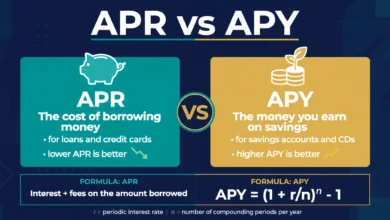
APY and APR look similar, but they measure opposite things. APY is what you earn on savings. APR is what you pay to borrow. APY includes compounding. APR, in the way it is usually quoted, does not. For the full comparison, see our APR vs APY comparison. Do not compare a loan’s APR with a savings account’s APY directly, because one is a cost and the other is a return.
Mistakes to Avoid With APY
The first mistake is choosing an account by its interest rate instead of its APY, or ignoring fees. APY includes no fees at all, so a high-APY account with a monthly fee can still lose you money on a small balance.
The second mistake is trusting a promotional rate without reading the terms. A savings account may advertise a high APY for three months, then drop to a much lower rate.
The third mistake is forgetting that most APYs are variable. Your rate can fall as well as rise. Check your rate once or twice a year, and move your money if a better account is available. Moving for 0.10% is rarely worth the effort. Moving for 1% or more on a real balance usually is.
The fourth mistake is keeping all your money in one balance with no goal. If one account holds your emergency fund, holiday fund, and new-phone fund together, you will spend it more easily. Use buckets or sub-accounts if your bank offers them. A high APY will not help if the money is gone before it can earn interest.
The fifth mistake is treating APY as a guarantee of wealth. APY tells you what you earn, not what you keep after tax and inflation. Interest is usually taxable income in the United States, and inflation can reduce what your money can buy. A 4% APY is a good deal for short-term savings, but it is not an investment. Build a small emergency cushion first, then think about long-term investing separately.
The Rule of 72: How Long Until Your Money Doubles?
The Rule of 72 is a quick way to see how long it takes for your money to double at a given APY. Divide 72 by the APY, and the answer is the number of years it will take, roughly.
At 0.39% APY, the national average, it would take about 185 years for your money to double. At 4.00% APY, it would take about 18 years. At 5.00% APY, it would take about 14.4 years. The rule is not exact, but it shows why APY matters over a long period. Regular deposits matter more than a slightly higher APY in the early years. The APY is the boost. The deposits are the engine.
| You may also like: |
|---|
| Personal Finance Management: A Complete Guide to Managing Your Money |
| Beginner Investment Guide: How to Start Investing with Confidence |
Frequently Asked Questions
What is a good APY for a savings account in 2026?
A good APY in 2026 is usually around 3.50% to 4.20% for a high-yield savings account, compared with a national average of about 0.38% to 0.39% for a regular savings account. Rates change often, so check the current rate before you open an account.
Is APY the same as the interest rate?
No. The interest rate is the nominal rate before compounding. APY is the rate after compounding is included. APY is always equal to or higher than the interest rate, and the two are only the same when interest compounds once a year.
How is APY calculated?
APY is calculated with the formula APY = (1 + r / n) ^ n – 1, where r is the nominal annual rate and n is the number of compounding periods in a year. For example, a 5% nominal rate compounded monthly is 5.12% APY.
Does a higher APY always mean a better account?
Not always. A higher APY is better only if the account has no monthly fee, or if the fee is waived at your balance, and if the APY is a regular rate, not a short-term promotion.
Can APY change after I open an account?
Yes, in most cases. Most savings accounts have a variable APY, which means the bank can change the rate at any time. A certificate of deposit usually has a fixed APY for its term.
Is my money safe in an account with a high APY?
If the bank is FDIC insured, deposits are insured up to $250,000 per depositor, per bank, for each ownership category. Always confirm FDIC insurance before you apply.
Conclusion
Annual percentage yield is the simplest way to compare savings accounts. It tells you, in one number, how much your money will earn in a year, including compound interest. It is required by law, so it is a fair comparison, and it already accounts for how often interest compounds.
Use APY to compare accounts, then check the fee, the minimum balance, and whether the rate is a regular rate or a promotion. Choose a no-fee, FDIC-insured account that pays its advertised rate on a small balance, set up a small automatic transfer, and let compounding do the work. The APY itself earns only a few dollars on $100 in its first year. The habit it supports, plus regular deposits, turns that $100 into a cushion you can rely on.
Start by checking the APY on the account you have now. If it is close to the national average, you are probably earning far less than you could. Moving your money takes about ten minutes, and the difference grows every year you leave it there.